Advanced PANS-OPS Course
Instrument Flight Procedure Design Training
COURSE OVERVIEW
This advanced course develops the ability to resolve complex conventional procedure design problems where terrain, obstacles, navigation aid geometry or segment interfaces constrain the layout. Participants compare design options, apply instrument landing system (ILS) Obstacle Assessment Surfaces (OAS) and document the technical basis for their selected solution and its independent check. Participant develops the main items of the design report under instructor supervision
Course Details
- Course Code:
- GACS-ANS-PO-02
- Duration:
- 3 Weeks
- Level:
- Advanced Technical Training
- Category:
- Air Navigation Services
- Language:
- English
COURSE OBJECTIVES
- Analyse complex navigation aid and fix geometry and assess the effect of tolerances on protection areas.
- Construct and compare turn, reversal, holding and DME arc solutions under limiting design conditions.
- Assess terrain and obstacles in primary, secondary and overlapping protection areas.
- Design non-precision approaches with step-down fixes and compare options for constrained arrivals and departures.
- Apply ILS OAS criteria, assess missed approach and circling constraints. Determine obstacle clearance altitude/height (OCA/H) as applicable.
- Recompute critical design results during an independent check and record findings, corrections and the design rationale through the final project.
WHO SHOULD ATTEND
- Qualified instrument flight procedure designers developing advanced conventional design skills.
- Air navigation service provider staff responsible for complex procedure design or maintenance.
- Civil aviation authority specialists involved in technical review, oversight, or procedure approval.
- Procedure design engineers preparing for senior design or independent checking responsibilities.
- Conventional procedure designers preparing for specialised PBN training and other suitably qualified aviation specialists.
ENTRY REQUIREMENTS / PREREQUISITES
Participants should have completed Basic or Initial PANS-OPS training or demonstrate equivalent competence. They need practical knowledge of conventional procedure design and obstacle assessment, using AutoCAD or equivalent CAD platform, and the ability to read and apply ICAO criteria in technical English.
PRACTICAL TRAINING
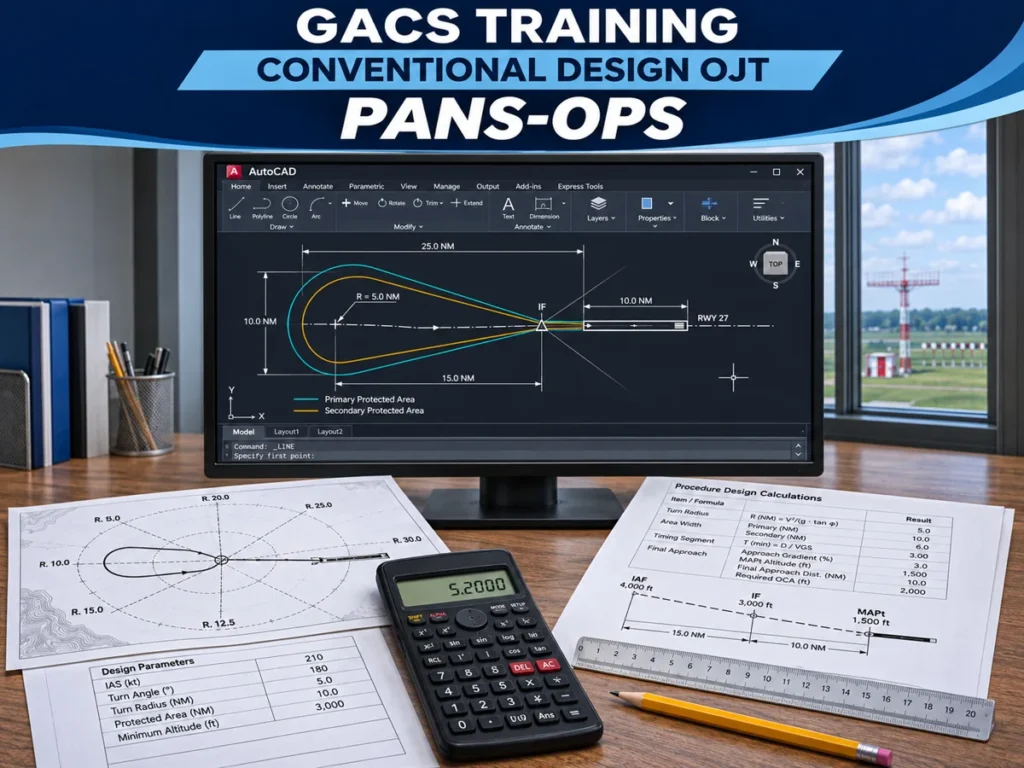
Participants use controlled data to assess an obstacle-constrained departure and construct representative ILS OAS geometry in AutoCAD. They compare alternative layouts, identify the controlling obstacles and independently review a design package containing deliberate errors.
KEY TRAINING TOPICS
- Navigation geometry. Assess complex VOR/DME fixes, fix tolerances and DME arcs.
- Turn protection. Compare base turns, procedure turns and holding geometry under applicable speed, altitude, bank and wind assumptions.
- Obstacle assessment. Check primary, secondary and overlapping areas and evaluate how alternative geometry changes the controlling obstacle.
- Arrival and departure integration. Check segment continuity, altitude constraints and required procedure design gradients.
- Conventional non-precision approach. Evaluate step-down fixes, descent constraints and final-to-missed-approach interfaces.
- ILS and OAS. Assess precision approach obstacles and compare straight or turning missed approach cases as applicable.
- Visual manoeuvring. Assess circling areas by aircraft category and check visual segment obstacles.
- Independent checking. Reconstruct critical geometry, trace inputs and document corrections and evidence for validation.
TRAINING METHODOLOGY
Instructor-led case work combines calculations, guidance of the professional IFP design, AutoCAD construction and technical review. Participants explain the constraints behind each design choice and address findings from guided independent checks. Insuring understanding of ICAO criteria Doc. 8168, and charting principles of showing the design different phases.
ASSESSMENT & CERTIFICATION
Assessment includes knowledge checks, practical design assignments, a written examination, and an individual final project. Participants present the project and its technical check. The GACS Certificate of Successful Completion requires at least 90% attendance, a minimum overall score of 70%, and satisfactory completion of the required assignments and final project.
INTERNATIONAL STANDARDS & REFERENCES
ICAO Doc 8168, Vol. II, Parts I and II — PANS-OPS general and conventional design criteria.
ICAO Doc 9906, Vols. 1 and 2 — Design quality assurance and designer training guidance.
ICAO Doc 9906, Vol. 5 — Instrument flight procedure validation guidance.
ICAO Annex 4 — Aeronautical charting standards.
ICAO Annex 15 — Aeronautical information services.
ICAO Doc 10066 (PANS-AIM) — Aeronautical data and information requirements.
COURSE DELIVERY & CUSTOMIZATION
The course is delivered in English at GACS facilities or at an approved client training facility. The recommended class size is up to 10 participants to allow close supervision during advanced design exercises.