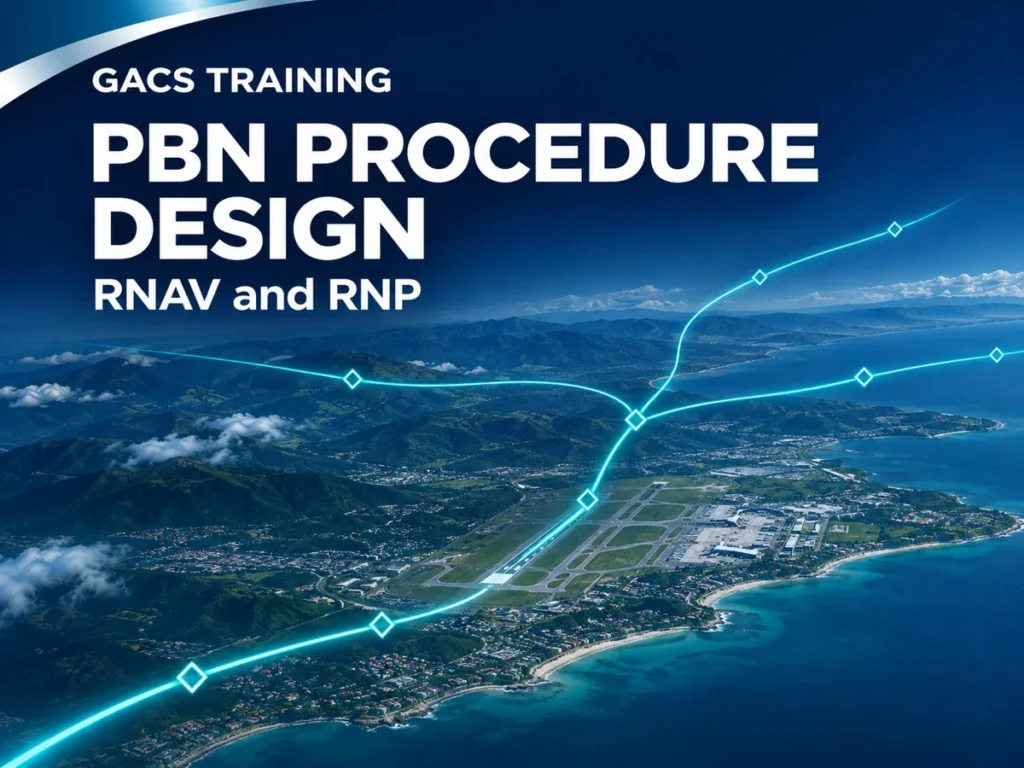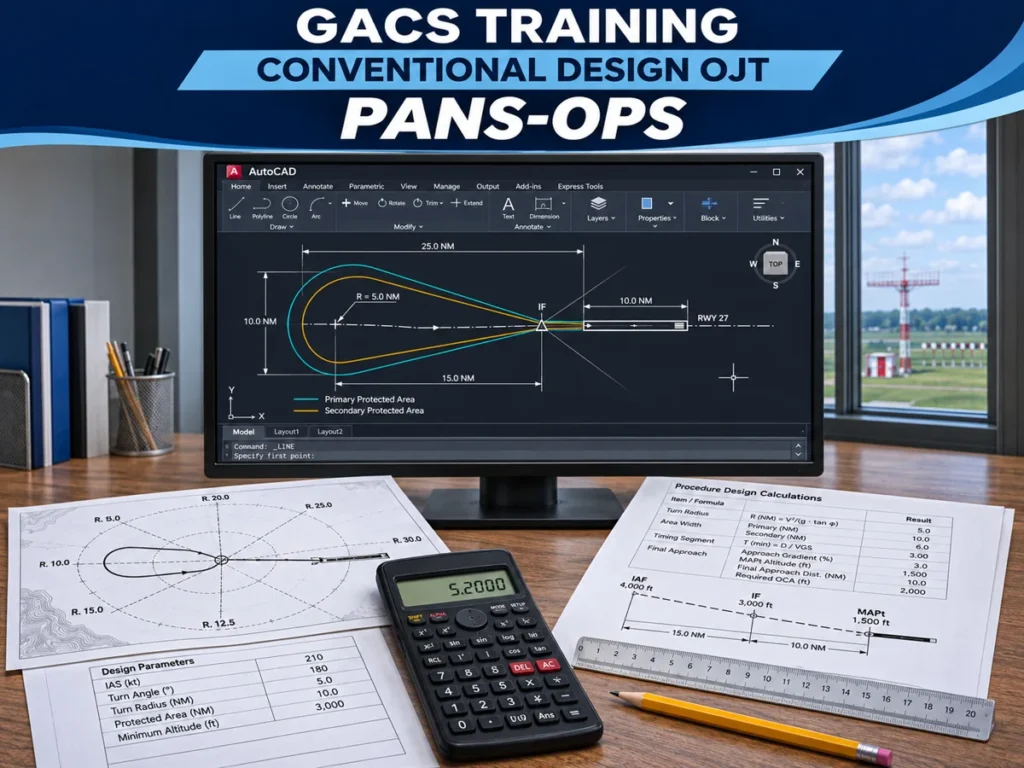
PBN Flight Procedure Design OJT (PANS-OPS)
Supervised On-the-Job Training in RNAV and RNP Procedure Design
COURSE OVERVIEW
This GACS on-the-job training (OJT) programme develops the ability to apply performance-based navigation (PBN) criteria to an assigned procedure or group of segments. Under consultant supervision, participants justify the navigation specification, construct the protected geometry, assess terrain and obstacles, and submit a design package that a reviewer can trace to the source data and applicable criteria. Consultant puts the design working map and the participants work independently step by step according to the design methodology as trained.
Course Details
- Course Code:
- GACS-ANS-PBN-OJT-01
- Duration:
- 3 Weeks
- Level:
- Supervised Practical Training
- Category:
- Air Navigation Services
COURSE OBJECTIVES
- Select an applicable RNAV or RNP navigation specification for the intended operation and explain the role of on-board performance monitoring and alerting for RNP.
- Define waypoint coordinates, nominal tracks and segment interfaces, and document the assumptions behind the selected layout.
- Apply along-track tolerance (ATT), cross-track tolerance (XTT) and applicable area widths to construct straight and turning protection areas.
- Apply minimum obstacle clearance (MOC) to the relevant protection areas and identify which obstacles control the design outcome.
- Compile traceable calculations, CAD drawings and an obstacle assessment record for technical checking.
- Record supervisor feedback, resolve review findings and document the evidence of performance for the assigned tasks.
WHO SHOULD ATTEND
- Instrument flight procedure designers who have completed PBN procedure design training.
- Trainee designers preparing to undertake RNAV or RNP design tasks under supervision.
- Air navigation service provider staff assigned to design, review or maintain PBN procedures.
- Procedure design engineers supporting PBN implementation who need supervised design practice.
ENTRY REQUIREMENTS / PREREQUISITES
Participants should have completed PBN procedure design training or demonstrate equivalent knowledge and experience. They should be familiar with RNAV and RNP design criteria, waypoint and leg construction, obstacle assessment and coordinate-based CAD drawings. Working technical English is needed to interpret criteria and document decisions.
PRACTICAL TRAINING
Using a controlled dataset, participants record the origin and revision of aeronautical, terrain and obstacle inputs, then build and check the geometry for an assigned departure, arrival or approach. The submitted package includes drawings, criteria and assumptions, obstacle calculations, the controlling obstacle and the disposition of review findings.
KEY TRAINING TOPICS
- Design brief and navigation specification. Confirm the intended operation, navigation infrastructure and functional requirements.
- Waypoint and segment geometry. Check waypoint positions, tracks, segment length and applicable ATT, XTT and area widths.
- Turn protection. Select fly-by or fly-over waypoints as applicable and account for speed, bank and wind when constructing and checking the turn area.
- Obstacle assessment. Apply the relevant MOC, including secondary-area treatment where applicable, and show how the controlling obstacle affects the design.
- Procedure integration. Check SID or STAR interfaces, applicable altitude or climb-gradient constraints, or RNP APCH segment transitions and missed approach protection, according to the assignment.
- Data and charting. Check waypoint coordinates, units and data provenance, and reconcile the proposed chart depiction with the design records.
- Design review. Record criteria references and calculation inputs, resolve findings and preserve the revision history.
- OJT evidence. Record observed tasks, feedback, corrections and the supervisor’s review of the resubmitted package.
TRAINING METHODOLOGY
The consultant agrees the tasks and expected outputs, observes critical design steps and reviews the trainee’s rationale for each decision. The trainee revises the package and records the evidence supporting each correction. The consultant assess each task before continuing its design phases.
ASSESSMENT & CERTIFICATION
Assessment draws on mentor observation and the documented design package. The final review considers criteria application, obstacle calculations, traceability and resolution of findings. GACS and the client agree the assignment completion and reporting requirements.
INTERNATIONAL STANDARDS & REFERENCES
ICAO Doc 8168, Vol. II, Part III — PANS-OPS criteria for PBN procedure design.
ICAO Doc 9613, Vol. II — RNAV and RNP navigation specifications.
ICAO Doc 9906, Vol. 1 — Design quality assurance and technical review.
ICAO Doc 9906, Vol. 2, Ch. 3 — Supervised on-the-job training.
ICAO Doc 10066 (PANS-AIM) — Aeronautical data and information requirements.
ICAO Annex 4 — Aeronautical charting standards.
COURSE DELIVERY & CUSTOMIZATION
GACS and the client agree the supervised assignments, working data and delivery arrangements. The programme runs for 15 working days, with 90 training hours.