Basic PANS-OPS Training Course
Instrument Flight Procedure Design Training
COURSE OVERVIEW
This initial course develops the skills to design, develop and assess conventional instrument flight procedures as ICAO Doc. 8168 criteria. Participants turn runway, navigation aid, terrain and obstacle data into protected tracks and documented clearance calculations. Guided work progresses from fix construction to departures, arrivals, non-precision approaches including missed approach and introductory instrument landing system (ILS) assessment.
Course Details
- Course Code:
- GACS-ANS-PO-01
- Duration:
- 5 Weeks
- Level:
- Basic Professional / Technical / Practical
- Category:
- Air Navigation Services
- Language:
- English / Arabic
COURSE OBJECTIVES
- Check coordinates, elevations, units and navigation aid data before constructing tracks and fixes.
- Apply aircraft category, speed, wind and bank assumptions to the applicable design case.
- Construct straight and turning protection areas and apply minimum obstacle clearance (MOC), including secondary-area treatment where applicable.
- Design conventional departure and arrival segments and check applicable climb or descent gradients.
- Construct a non-precision approach through missed approach, and apply introductory ILS and circling obstacle assessment criteria.
- Identify controlling obstacles and prepare calculations, drawings and assessment records for technical checking.
WHO SHOULD ATTEND
- Instrument flight procedure designers, ANSP technical personnel, and staff preparing to join instrument flight procedure design units.
- Civil aviation authority technical staff and inspectors, and aeronautical engineers.
- AIS/AIM personnel supporting procedure development and aeronautical cartographers.
- Airport and airspace planning specialists.
- Military air traffic controllers and navigators involved in military airspace planning.
ENTRY REQUIREMENTS / PREREQUISITES
Participants should preferably have basic knowledge of air navigation and aviation operations, familiarity with aeronautical data and navigation concepts, and basic mathematical and geometric skills. Previous experience in air navigation, aviation engineering, AIS/AIM, ATC or related disciplines is advantageous.
PRACTICAL TRAINING
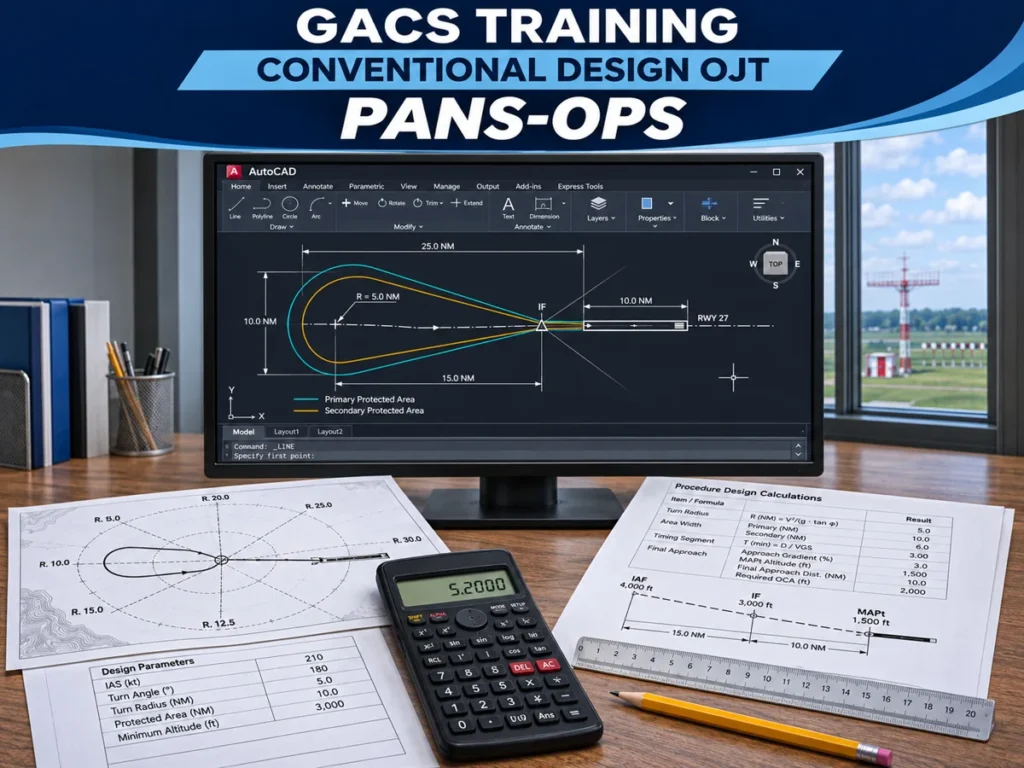
Using representative aerodrome and obstacle datasets, trainees plot conventional fixes and tracks in AutoCAD platform, construct protection areas and calculate obstacle clearance. The integrated project brings the drawings, calculations and controlling-obstacle record together in one design file for review. ICAO criteria transformation through progressive practical sessions under consultant supervision. Also charting principles of developing the IFP chart as ICAO standards.
KEY TRAINING TOPICS
- Design inputs. Check runway and navigation aid coordinates, elevation references, units and source data.
- Navigation geometry. Construct VOR radial and DME distance fixes and apply the relevant tolerances.
- Protection areas. Construct straight segments, turns, reversals and holding areas using the applicable design assumptions.
- Obstacle assessment. Apply primary and secondary area criteria and trace the controlling obstacle to the design result.
- Departure and arrival. Check departure climb gradients, minimum sector altitude and links to the approach.
- Non-precision approach. Connect initial, intermediate, final and missed approach segments and assess clearance.
- ILS and circling. Apply introductory precision approach and visual manoeuvring criteria in supervised exercises.
- Design documentation. Record data sources, calculations and drawings so another designer can check the work.
TRAINING METHODOLOGY
Instructor-led sessions pair criteria interpretation with guided calculations and AutoCAD construction. Participants review their own results against the design criteria and address instructor feedback before submitting the final project. A course handbook supports the exercises.
ASSESSMENT & CERTIFICATION
Assessment includes practical exercises, design assignments, a written examination and an integrated project. The GACS Certificate of Successful Completion requires at least 90% attendance, a minimum overall score of 70% and satisfactory completion of the required practical work and final project.
INTERNATIONAL STANDARDS & REFERENCES
ICAO Doc 8168, Vol. II, Parts I and II — PANS-OPS general and conventional design criteria.
ICAO Doc 9906, Vols. 1 and 2 — Design quality assurance and designer training guidance.
ICAO Annex 4 — Aeronautical charting standards.
ICAO Doc 8697 — Aeronautical Chart Manual.
COURSE DELIVERY & CUSTOMIZATION
GACS delivers the course at its facilities or at the client’s premises and can arrange dedicated institutional programmes. Course content and duration may be tailored to the client’s operational, regulatory, or organisational requirements. Training can be delivered in English, Arabic, or both.