PBN Procedure Design (PANS-OPS) – RNAV and RNP
Performance-Based Navigation Training for Flight Procedure Designers
COURSE OVERVIEW
This course develops the skills to design, develop, and assess performance-based navigation (PBN) procedures. Participants apply area navigation (RNAV) and required navigation performance (RNP) specifications to instrument departures, arrivals and RNP APCH, then document the navigation assumptions, protected geometry and obstacle assessment for technical review and technical reprot.
Course Details
- Course Code:
- GACS-ANS-PBN-01
- Duration:
- 3 Weeks
- Level:
- Advanced Technical Training
- Category:
- Air Navigation Services
- Language:
- English
COURSE OBJECTIVES
- Select an applicable RNAV or RNP navigation specification and explain on-board performance monitoring and alerting for RNP.
- Define waypoints, tracks and legs and apply along-track tolerance (ATT), cross-track tolerance (XTT) and applicable protection widths.
- Construct fly-by and fly-over turn protection as applicable, apply minimum obstacle clearance (MOC) and identify controlling obstacles.
- Design RNAV and RNP standard instrument departures (SIDs) and standard instrument arrivals (STARs) and check their interfaces.
- Design RNP APCH with LNAV minima and apply barometric vertical navigation (Baro-VNAV) criteria for LNAV/VNAV minima.
- Compile traceable design calculations, drawings and obstacle records for checking and validation.
WHO SHOULD ATTEND
- Qualified and trainee instrument flight procedure designers who should proceed for PANS OPS more qualification.
- Air navigation service provider (ANSP) staff who design, review or maintain RNAV and RNP procedures.
- Civil aviation authority specialists responsible for procedure oversight or approval.
- Procedure design engineers and technical staff involved in PBN implementation.
- Conventional procedure designers transitioning to PBN.
ENTRY REQUIREMENTS / PREREQUISITES
Participants should have completed Initial or Basic PANS-OPS training or demonstrate equivalent knowledge and experience. They should understand conventional departure, arrival and non-precision approach design, navigation systems, aeronautical data and obstacle assessment. Basic AutoCAD or equivalent CAD skills and the ability to apply ICAO criteria in technical English are required.
PRACTICAL TRAINING
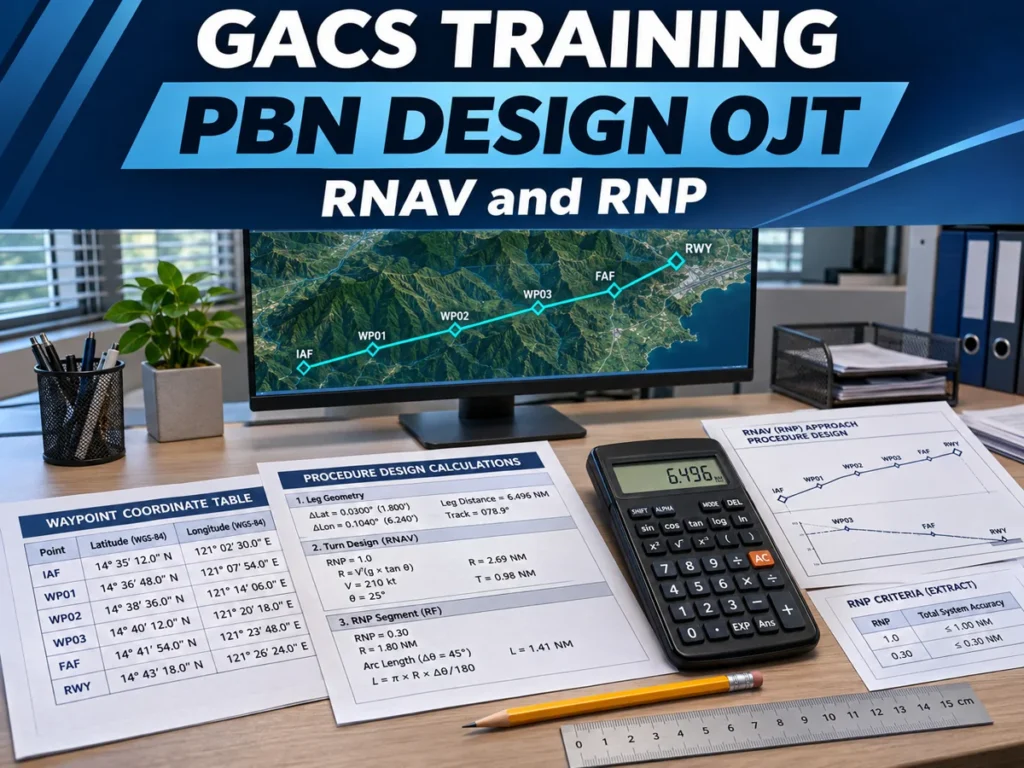
Using controlled aeronautical, terrain and obstacle data, trainees construct waypoints, tracks and turn protection in AutoCAD. They design and cross-check a SID, a STAR and an RNP APCH with LNAV minima, then assess the vertical path and obstacles in a Baro-VNAV exercise. Final project on PBN procedure under instructor supervision and assessment.
KEY TRAINING TOPICS
- PBN design basis. Check the intended operation, navigation infrastructure and functional requirements.
- Waypoint and leg geometry. Check segment lengths, ATT, XTT and protection widths.
- Turn protection. Evaluate fly-by and fly-over construction using applicable speed, bank and wind assumptions.
- Obstacle assessment. Apply MOC in relevant areas and record the controlling obstacle and its effect on the design.
- SID and STAR design. Integrate turns, altitude constraints and applicable departure climb gradients.
- RNP APCH. Check segment transitions and missed approach protection for LNAV minima.
- Baro-VNAV. Assess vertical path geometry, temperature considerations and vertical obstacle clearance for LNAV/VNAV design.
- Design review. Reconcile drawings and records with charting and coding considerations and prepare evidence for validation.
TRAINING METHODOLOGY
Instructor-led design exercises progress from individual segments to integrated procedures. Participants trace calculations to source data, identify deficiencies in a sample design package and address findings before submitting the final project.
ASSESSMENT & CERTIFICATION
Assessment includes knowledge checks, practical design assignments, a written examination and an individual final design project. The GACS Certificate of Successful Completion requires at least 90% attendance, a minimum overall score of 70% and satisfactory completion of the required practical work and final project.
INTERNATIONAL STANDARDS & REFERENCES
ICAO Doc 8168, Vol. II, Parts I and III — PANS-OPS general and PBN design criteria.
ICAO Doc 9613, Vol. II — RNAV and RNP navigation specifications.
ICAO Doc 9906, Vols. 1 and 2 — Design quality assurance and designer training guidance.
ICAO Annex 4 — Aeronautical charting standards.
ICAO Annex 15 — Aeronautical information services.
ICAO Doc 10066 (PANS-AIM) — Aeronautical data and information requirements.
COURSE DELIVERY & CUSTOMIZATION
The course is delivered in English at GACS facilities or at an approved client training facility. The recommended class size is up to 10 participants to support supervised design work.