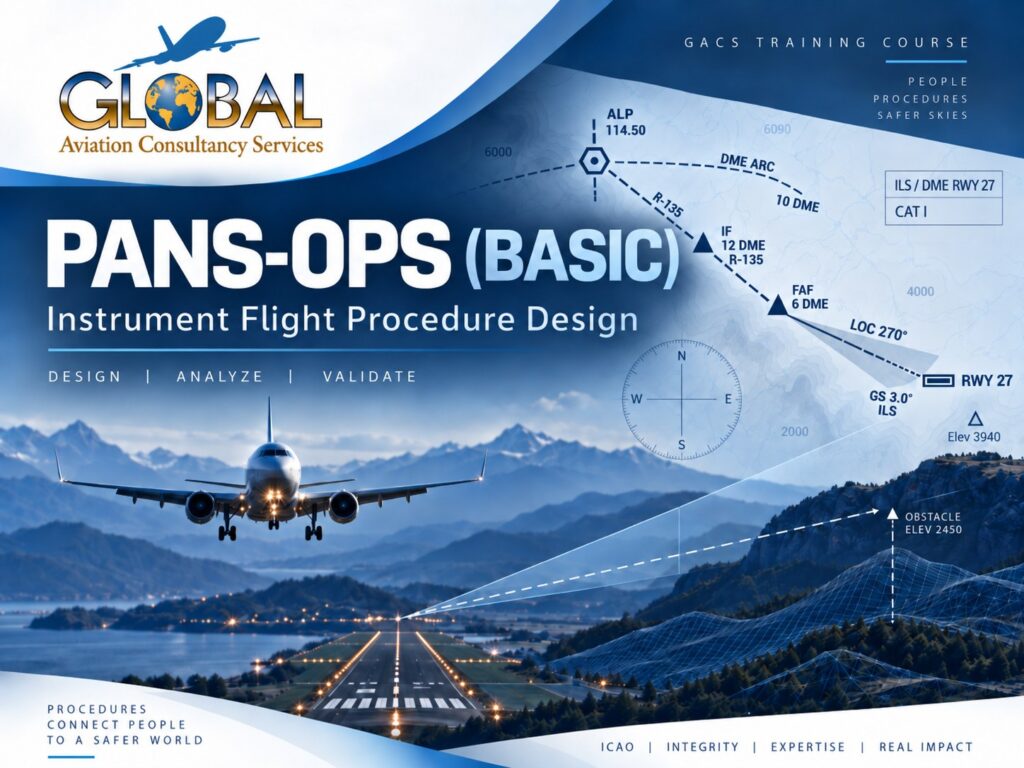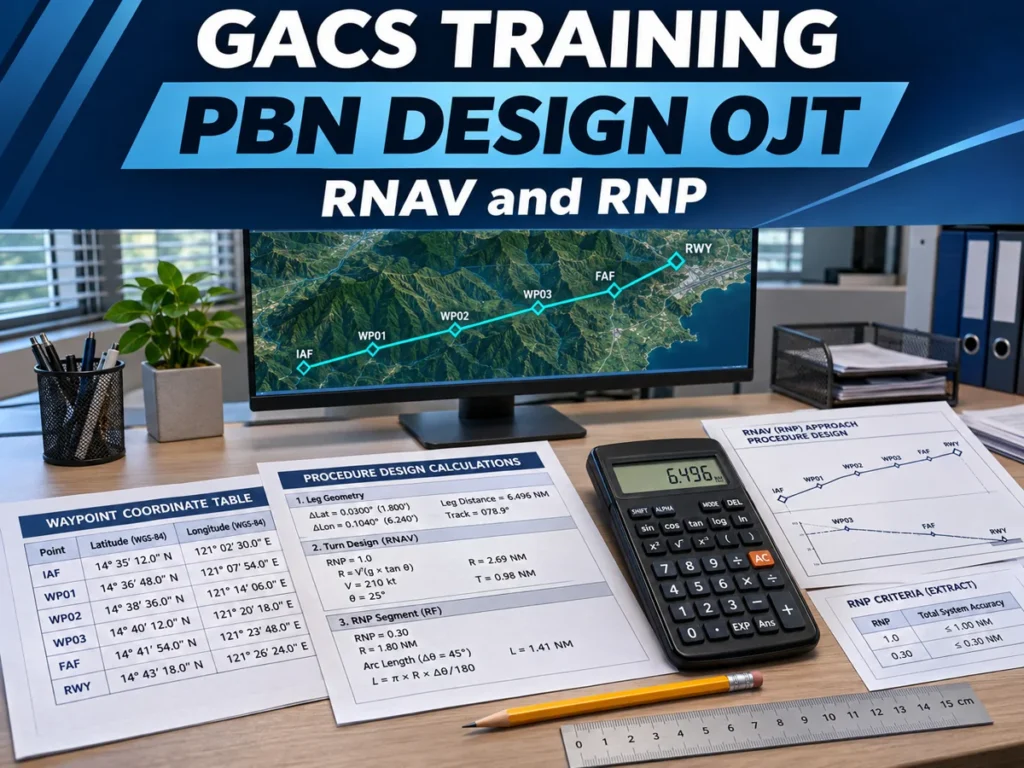
Conventional Flight Procedure Design OJT (PANS-OPS)
Supervised On-the-Job Training for Instrument Flight Procedure Designers
COURSE OVERVIEW
This GACS on-the-job training (OJT) programme develops the ability to apply conventional PANS-OPS criteria to an assigned instrument flight procedure or group of segments. Under supervision, participants establish the design basis, construct protection areas, assess obstacles and produce a design package that a technical reviewer can trace to the input data and applicable criteria. Design report is part of the OJT under course elements.
Course Details
- Course Code:
- GACS-ANS-PO-OJT-01
- Duration:
- 3 Weeks
- Level:
- Supervised Practical Training
- Category:
- Air Navigation Services
COURSE OBJECTIVES
- Confirm the assigned procedure type, runway or threshold reference, navigation aid and operational constraints before choosing the design criteria.
- Verify aeronautical data, terrain and obstacle inputs and record their provenance, coordinate reference system, elevation datum and units.
- Understanding ICAO criteria through progressive reading details for each segment and connection concept.
- Construct nominal tracks and fixes using applicable navigation aid tolerances, then delineate straight and turning protection areas.
- Calculate minimum obstacle clearance (MOC) for the relevant areas, identify controlling obstacles and derive the applicable design result.
- Prepare traceable calculations, CAD drawings and an obstacle assessment record for technical design report.
- Resolve technical review findings and record evidence of performance for the assigned design tasks.
WHO SHOULD ATTEND
- Instrument flight procedure designers who have completed conventional PANS-OPS level training.
- Trainee designers preparing to undertake conventional procedure design assignments under supervision.
- Air navigation service provider staff assigned to design or review conventional flight procedures.
- Procedure design engineers returning to conventional design work who need supervised practice.
ENTRY REQUIREMENTS / PREREQUISITES
Participants should have completed PANS-OPS training, or demonstrate equivalent knowledge and experience. They should be familiar with conventional procedure design, aeronautical data, obstacle clearance calculations and coordinate-based CAD drawings. Working technical English is needed to interpret criteria and record design decisions.
PRACTICAL TRAINING
Using a controlled dataset, participants verify runway and navigation aid inputs, construct assigned segments and calculate obstacle clearance. They submit a design file with referenced criteria, inputs, drawings and a controlling-obstacle record, then document their responses to technical review. Client may bring a real airport data to use it as OJT under the instructor supervision.
KEY TRAINING TOPICS
- Design brief and input checks. Verify runway and navigation aid coordinates, elevations, datum, units and dataset revision.
- Track and fix construction. Apply the applicable VOR or DME tolerances and check segment interfaces and area widths.
- Straight and turning protection. Select the applicable construction method and document speed, bank and wind assumptions where relevant.
- Obstacle clearance. Apply MOC in primary and secondary areas where applicable, then show how the controlling obstacle affects the result.
- Procedure integration. For departures, check the DER and applicable design gradient. For approaches, check applicable descent gradients, missed approach protection and obstacle clearance altitude/height (OCA/H).
- Design records and charting. Reconcile tracks, fixes, altitudes and design restrictions with the proposed chart depiction.
- Technical review. Trace each calculation to its inputs and criteria, record findings and retain the revision history.
- OJT evidence. Record observed tasks, mentor feedback, corrections and review of the revised submission.
TRAINING METHODOLOGY
The consultant agrees the tasks and expected outputs, observes critical design steps and reviews the trainee’s rationale in addition to clarify critical points in Doc. 8168 criteria. The trainee revises the package and records the evidence supporting each correction.
ASSESSMENT & CERTIFICATION
Assessment draws on mentor observation and the submitted design file. The final review considers criteria application, obstacle calculations, traceability and resolution of findings. GACS and the client agree completion and reporting requirements.
INTERNATIONAL STANDARDS & REFERENCES
ICAO Doc 8168, Vol. II, Parts I and II — PANS-OPS general and conventional procedure design criteria.
ICAO Doc 9906, Vol. 1 — Design quality assurance and technical review.
ICAO Doc 9906, Vol. 2, Ch. 3 — Supervised on-the-job training.
ICAO Doc 10066 (PANS-AIM) — Aeronautical data and information requirements.
ICAO Annex 4 — Aeronautical charting standards.
COURSE DELIVERY & CUSTOMIZATION
GACS and the client agree the supervised assignments, working data and delivery arrangements. The programme runs for 15 working days, with 90 training hours.